14 February 2013

Warm Bodies Review


When it comes to the zombie apocalypse, romance is hardly on the cards. Yeah, you can meet someone nice, and yeah, you'll have a whale of a time trying to survive, but social connections formed in apocalyptic scenarios are invariably based on desperation and little else, bringing together folk who might otherwise have never interacted. The genre - for all its horror trappings - feeds off of these mismatches in unforgiving circumstances to create engaging human drama. The zombies are set dressing - horrible, flesh eating set dressing, yes, but set dressing nonetheless. They're not meant to be engaged with. Are they?

Imagine, if you will, my conjecture being vocalised in an abandoned bar to you, my fellow survivor. Suddenly, the door crashes in, and in shambles a zombie, a sticker with 'Hi! My name is Warm Bodies!' on its chest. But instead of trying to open our skulls like tinned chilli, he takes a seat, and tries to answer that question. Sums up the movie, really.

Back to reality, with its male romantic lead a zombie, it's a clear attempt to take a fresh approach on no less then two genres. The mythology has obviously been adapted accordingly - one can hardly have a romance without a spot of spurning your brethren in its pursuit - and here, they're divided into two subsets. The first are the walking social commentaries featured in Romero's films: retaining some sense of who they were, and when not feasting on cerebellum, they're emptily going through the motions of a life half-remembered. Then there's the 'bonies', eyeless bags of bone and sinew, beyond saving and devouring anything with a heartbeat.

It's an interesting play from the writers, and from a script point of view, it's difficult to fault beyond proceeding exactly as you might expect it to. So much so that I'm skipping sumarising the plot as a challenge to any reading this! This isn't restricted to the narrative either, with a few of the jokes only really funny because they may have crossed your mind when you were watching the same situation played straight elsewhere.

But the laughs are there to be had - several, in fact, and good ones too - with the cast making a decent job of it. Nicholas Hoult and Rob Corddry's comic timing - and that's pretty much all they've got at their disposal here - are the stars of the show, bouncing off each-other and co-star Teresa Palmer enjoyably enough to buoy her enticing but ultimately uninteresting portrayal of The Girl (TM). John Malkovich is on autopilot in his role as the merciless military commander of the survivors - even the addition of Over-Protective Father (TM) hardly challenges him - so if you're hoping for something as fun as his turns in RED or Con Air, you'll need to keep looking. The rest are unremarkable, but never bad.

The almost inevitable let down is in the execution. Whilst it's entirely competent from a technical standpoint, there was an decision made to open it up to the audience that it shares bare plot bones with - human falls in love with supernatural creature, and you can read that however you like. The result, stylistically, is a removal of bite from the human/zombie interaction. It's completely bloodless, and lacks a single proper scare - earning a 12A from the BBFC, the horror tagged as 'moderate'. Seeing as the horror is what would ostensibly be the forbidden aspect of this love story, this in turn undermines the romance, leaving the comedy to do the bulk of the entertaining, and this can't quite fill the two gaps. It's a story that, had they made the horror aspects horrifying, could have been an unexpected delight.

Furthermore, the lack of horror is a curious decision insofar as it's a clear pastiche of the supernatural romance - taken to a logical extreme, as pastiches invariably are. To open it up to the audience you're winkingly ripping into, and completely de-clawing your movie in the process, is bordering on madness.

It's also a touch too long, meandering between plot points without any sense of urgency or threat, and it verges on outstaying its welcome in the flat finale. There's a tight, funny, blooded movie in the vein of Zombieland and Shaun of the Dead to be had from this story, and it's disappointing that this one squanders a good portion of its potential.

Still, the ideas at its core are good, it's at least competently executed, and the comedy does work, even if you're mouthing the punch lines as they're projected. It's a shame the other two aspects of the story are so toothless, caught in a viscous cycle stemming from a business decision. But this is Hollywood, so having your figurative guts ripped out so more people will see you is par for the course. That the carcass is still entirely watchable is a testament both to the strength of the idea, and to the two male leads' zombified chemistry. Not one to rush out and see, but worth a look down the line.

23 January 2013

The Hobbit: An Unexpected Journey Review


The time has come once again, young friends, to grab your walking stick, saddle up your pony (who's hopefully called Bill) and prepare for a trek through Middle Earth once again - for the first of Peter Jackson's latest string of Tolkien adaptations is upon us, and thankfully, whilst it's not an absolute triumph, it's entertaining enough to keep your eyes glued to the screen.

If you're unfamiliar with the close-to-legend plot of the Hobbit, do yourself a favour: stop reading this review, and go buy a copy of The Hobbit. This'll still be here when you're finished. But for the lazy: wizard recruits titular little person to aid a group of thirteen other little (but slightly bulkier) people in their quest to reclaim their kingdom from the dragon what nicked it. Or to put it another way - it's another movie about fucking walking from the fucking Shire to a fucking mountain in the east.

Don't let the pithy plot summary dissuade you, though, as Mr Jackson has done a sterling job of fleshing out the plot of the book - and whilst superficially, the plots are similar, there's a lot of emphasis placed on the telling, rather than the plot turns themselves. The embellishments on the six chapters of the novel that this, the first of three movies is based on is pleasing enough, mercilessly foreshadowing the dark times to come, and expanded on a few passingly-mentioned characters, upgrading Azog the Goblin from a long-dead enemy to a secondary antagonist, as well as an expanded role for Radaghast the Brown. As Gandalf muses at the start of the film: 'all good stories deserve embellishment', and whilst they may not sit entirely comfortably with Rings enthusiasts and scholars, in terms of the films structure, they work wonderfully.

Stylistically, the change between the Lord of the Rings and The Hobbit films is similar to the books - The Hobbit playing lighter and with a touch more humour about it, which Jackson translates to film elegantly whilst still maintaining his penchant for the visually epic and arresting. It doesn't quite reach the highs of the first of his previous trilogy, thanks to a relative lack of investment in the characters, and a strange bloodlessness that removes any real sense of threat. They're still visually arresting, and not without a touch of wit, but there's nothing that can quite match the Mines of Moria sequence here, despite their best efforts.

From a technical standpoint, it's difficult to say exactly where I sit. 3D here is as perfunctory as it ever was - though there are a couple of moments where it's used to good effect, it still feels like a lame excuse to charge more for the entry fee. It is, however, the crispest 3D I've experienced since Avatar, thanks to the 4K resolution and high frame-rate filming. Unfortunately, this added fidelity can on occasion draw attention to the seams in...well...everything. From the irritatingly obvious join between actor's skin and skull-cap on Dwalin's head, to the almost toy-like quality of the various weapons wielded - now that we can see every tiny detail of a scene, it's easier than ever to have your suspension of disbelief come crashing back down to earth. The sheer breadth and majesty of Jackson's vision, as well as the absolutely stellar CGI work, go a long way to mitigating this, but as stated, such little irritations can prove distracting.

Fortunately, the film is strongest when looking at it from a performance point of view - assisting in drawing your attention away from the visual oddities. Particular credit should go to James Nesbitt, Ken Stott, Dean O'Gorman and Aidan Turner, all bringing stoic turns with just the right amount of humour to their respective dwarves. Martin Freeman is great as Bilbo, and his scene with the always fantastic Andy Serkis - returning as Gollum - is as pitch perfect a rendition as one could possibly hope for. Richard Amitage is perhaps a touch flat as Thorin Oakenshield, and the rest of the dwarves aren't really given enough screen time to really appreciate.

The most inspired bit of casting, however, must go to Slyvester McCoy as Radaghast - a shambling living earth-pile of a wizard who none-the-less displays the spryness of his less disheveled counterpart Gandalf - who is still elegantly played, less grumpy this time, by Ian McKellen. Whilst his scenes are almost entirely the creations of Jackson, Walsh and Del Toro's screenplay, McCoy plays them with a sly absent-mindedness that belies an over-active mind and his presence is missed after he vanishes about half way through the movie.

Overall, An Unexpected Journey isn't quite the tantalising prospect of adventure that The Fellowship of the Ring was - in part due to it all feeling a little bit like a retread with less blood and more slapstick comedy - but it's still hugely enjoyable, and even though it's a stately 169 minutes long, it never feels it, and come the end, Smaug's desolation in December 2013 can't come fast enough.

5 November 2012

Skyfall Review


Carrying a legacy is no mean feat, by any stretch of the imagination - and it's more difficult than one might be able to conceive if that legacy is the James Bond film franchise, in it's 50th anniversary year. Couple this with a Bond whose appearance has divided critics and audiences alike, along with it being a follow-up to the relatively lacklustre Quantum of Solace, and you'll begin to get a sense of just how much was riding on Skyfall.

It's a relief to report, then, that Sam Mendes has absolutely nailed it. There are a couple of snags at script level, but ultimately, this is an absolute return to form for the franchise - an ensemble cast that's never been finer, a story that neatly subverts a few stale tropes as it establishes a new status quo, whilst at the same time acknowledging the 50-year-old legacy that preceded it with a degree of subtlety that's almost unprecedented.

It may have initially seemed like an odd choice for director, given his previous films - but Mendes is a genuine revelation as an action director. From the initial chase sequence that ticks every box you could imagine - cars, motorbikes, parkour and trains - to guerilla warfare in an abandoned old house, every beat of action is exciting, entertaining and above all, gloriously captured by Roger Deakins. The film's crowning moment - at least in my not-so-esteemed opinion - is the set piece involving Bond trailing and ultimately confronting an assassin in a glass office. A masterstroke of effectively setting tension before an action sequence, and then properly framing it - there's some cat-and-mouse play as Bond hides in the reflections in the glass, and the subsequent fist-fight between the two is done in a single slow zoom, silhouetted by the blue neon sign on the building behind them. It's one of those 'wow' moments unique to cinema, and I challenge you to sit through this scene without your jaw knocking out the person sitting in front of you.

What's great about the direction is that there's an effort to connect Craig's newer, grittier Bond with the suave aloofness of Brosnan, Connery and Moore. Little details abound in each scene and set-piece that link the four portrayals together. There's also some interesting questions raised about just how useful an individual like Bond is in the age of digital intelligence. As Ben Wishaw's new incarnation of Q puts it: "I can do more damage on my laptop, sitting in my pajamas, before my first cup of Earl Grey than you can do a year in the field. But sometimes, a trigger needs to be pulled". The conclusion it draws? Very useful indeed - but that's the rub of the piece, and you should see it yourself for just how it comes to this.

Performance-wise, Daniel Craig continues to do his best to become everyone's new favourite Bond, and as said, there's a real effort, both from Mendes and from Craig himself to connect the blunt instrument of Casino Royale to the sophisticated, dapper agent that we were used to before he rocked up. Javier Bardem is deliciously unsettling as Silva, the villain of the piece - he's a nod to the slightly camper days of old, but coupled with a disturbing twist that creates a genuinely memorable villain. Judi Dench provides no evidence against the ostensible fact that she can't put in a bad performance as M, and welcome additions to the cast in the form of Naomi Harris and Ralph Fiennes help round out what is a fantastic ensemble.

It's perhaps a bit of a disappointment that the story sags a little in the middle, but this is mainly due to an unreasonable number of intriguing plot threads being juggled rather deftly, and physics dictates that there's going to be some form of inevitable downward motion, so it's easy to overlook this when taking the film in in its entirety. Less forgiveable is the glossed-over motivation of Silva, which feels a little too-quickly explained and poorly emphasised. It would've perhaps been more interesting to make him a Joker-like character - "Some men just want to watch the world burn" - rather than try to hastily cram an explanation into expositionary dialogue. Still, Bardem's interpretation of the character is so strong, so beautifully off-putting, that you'll simply be glad he gets to clash with Bond at all.

Ultimately, these two minor hiccups do prevent the film from taking its place alongside the likes of Goldeneye and Goldfinger - but the gap isn't exactly what one might refer to as large. It's exciting, it's engaging, it's thoughtful, and it's iconic, with a best-yet performance from Mr Craig. See it, and - if you're like me - see it again shortly afterwards.


29 October 2012

Looper Review


Warning: Mild spoilers-by-inference contained within.

Perhaps the key to making a successful sci-fi film is to ensure that no matter how grand your ideas get, you always ground them in a relatable reality. Avatar was grounded by the incredible detail in its special effects. Moon was grounded by an incredibly human performance from Sam Rockwell. Eternal Sunshine of the Spotless Mind (yes, it counts as sci-fi) was grounded by its central love story. And The Matrix? That was grounded by centralising an all-too-inevitable conflict between humanity and artificial intelligence.

After the event, the fact that Looper has been even mentioned in the same breath as The Matrix is somewhat confusing - there isn't a single shade of the Wachiowski brothers' opus here.

The story goes that in 2074, time travel is invented, but is immediately outlawed. That of course doesn't stop criminals from putting it to nefarious means, using the technology to circumvent their time's ability to track corpses - hurling people they want dead back in time to be murdered by people known as 'loopers' in 2044. When the time comes to end a looper's contract, they are sent back to get killed by themselves for a retirement-grade payday - a process known as 'closing the loop', and hence the name of the job.

If anything, this should've been coined as Back to the Future's psychotic younger cousin - it's newer, angrier and a whole lot more complicated. But the key difference that sets this apart from The Matrix - and indeed Back to the Future - is that the latter two work. Sadly, Looper does not.

At least, not fully - I'm not necessarily saying that it's without merit. The central premise of time-travel as a means of assassination is one of the best ideas to be committed to film in quite a while, and it gives way to an astonishing sequence involving one of the titular loopers, his future self and a surgery table that is beautifully unsettling. If nothing else, it proves that Rian Johnson has come into his own as a director - everything is handled with a dark, dry sense of humour that has come to be his unique selling point even in the disappointing The Brothers Bloom.

Joseph Gordon-Levitt and Bruce Willis are also fantastic as the present and future versions of Joe, with Gordon-Levitt in particular nailing the speech patterns and mannerisms of a 1980s Bruce Willis. This, coupled with the extensive make-up disguising him, makes for a compelling dynamic between these two aspects of the same character, and the best character moment is shared between the two in a Pulp Fiction-style stare-down in a remote diner. Jeff Daniels is laconically menacing as the mob boss who runs the loopers, and Noah Segan's bug-eyed secondary antagonist is a spluttering, incompentent joy to behold - the indignation when he's asked if he's blown off his other leg is fantastic.

But despite the best efforts of everyone involved, the movie ultimately comes to rely on three central conceits that aren't particularly grounded. The first is that the film's take on time travel is not particularly consistent - not being able to choose between Twelve Monkeys' approach of one set timeline in which everything has already happened, and BttF's multiple timeline's approach. The stuff involving telekinetic powers is clearly just shoe-horned in to up the visual spectacle, and could've easily been excised whilst preserving the narrative.

The final, crippling conceit, however - and this is the one large spoiler that you may wish to avoid - is the fact that the loopers are armed with weapons that cannot fire further the 15 feet. It's frankly ridiculous, and never properly explained - 'just because' is the best Johnson can come up with - but two of the film's major set pieces (including the chaotic finale) rely on this fact, and it completely undermines the joy of the admittedly spectacular sequences.

Disappointing would be the word of choice on this one, though a part of this is the comparisons with The Matrix colouring my expectations. But even discounting this fact, the best that can be said about it is that it's an admirable mess, much like The Brothers Bloom that preceeded it. Johnson has a real talent for direction, but it's possible that self-indulgence is getting the better of him, and it may be time for him to direct something that he didn't write himself.

But it's still certainly worth a look - the performances are great, the premise sound and inconsistencies aside, the story progresses in a relatively satisfying manner, with some excitingly played set pieces. It's also darkly amusing to boot - it's just such a shame that the story doesn't hold up to closer scrutiny. Have a pinch of salt ready, but otherwise, there are worse ways to spend two hours at the movies.


10 October 2012

Dredd 3D Review


Character development is an interesting thing - whilst it's more or less essential for making a movie whose timeline encompasses the passing of a few weeks or months, what if a movie takes place more-or-less in real time? Can character development be sidelined in favour of character presentation? Can we get to know and even like a character based purely on their actions within a certain scenario?

'Yes', is the reverberating answer that Dredd 3D tries to drill into you like a slow-motion bullet to the brainpan, and ultimately, it's quite successful. It's intriguing and exciting to see a comic-book movie that is not overly concerned about extolling an origin for its primary protagonist, instead opting for exploring the characters by having them react to a scenario, all of which is set up in a swift and elegant first 10 minutes.

For those of you unfamiliar with Judge Dredd - and to be fair, I was hardly what one might refer to as an expert - he, and his fellow Judges, are the logical extreme of the American system of law. Judge, jury and executioner all rolled into one, Judges are empowered to apply the law as and when they see fit in the MegaCities of the future that serve as their jurisdiction. In one such MegaCity - where crime and drug abuse are rampant - Judge Dredd and his fresh-out-of-the-academy partner Judge Anderson are called to a triple homocide in a tower block - and whilst murder is never simple, these get particularly complicated particularly quickly.

What follows this set-up is more or less 80 minutes of action, with a few stops for breath. It's beautifully filmed and directed, and whilst the 3D can feel a little perfunctory for the majority of the movie, there are a handful of moments that do make it worth sitting with those awful glasses on your face - not that you have much of a choice in the matter, if you wish to see the movie, given that there's no 2D release.

However, any sequence which involves the MacGuffin narcotic 'Slo-Mo' is a treat, with the water droplets and shards of glass suspended amid over-saturated, prismatic colours, that quickly drop back to the dull grey of the unenhanced world. It elicits a modicum of sympathy for the characters that do use it - it's a way for them to escape their colourless existence in what may well be the closest thing to an actual Hell on Earth.

The action packs a fairly meaty punch, too, with visceral slow-motion shots of bullets entering faces, chests, legs and other appendages from a variety of angles. There's some grim satisfaction, as well as mild horror to be had here, and the efficiency with which Dredd cleans up the bad guys is both impressive and a little unsettling, with the more tactical set pieces unfolding at such a blistering pace, and yet precise, technically accomplished camera allows the audience to keep up with it beat for beat.

Performance-wise, there're no weak links. Karl Urban - or at least, Karl Urban's face from the nose down - is great as Dredd, all dogged surliness and pinpoint markmanship. He also gets the best lines in the film, and delivers them with a snarl that is pitch perfect to the character. The lion's share of the character development goes to Olivia Thrilby as Judge Anderson, and she does a convincing job of finding the grey areas in Dredd's black and white morality. Lena Headley is quietly menacing as the primary antagonist Ma-Ma, and a slew of strong bit players help to create a convincing world of rather facistic oppression.

It sags a coupled of times between action sequences, and there's not as much satire as one might've hoped for, with Alex Garland himself admitting that the script was written as a wide-eyed teenager might interpret the character and world. It's still funny, but in a badass, one-liner way rather than as a skewering of the establishment. But given its strengths, it's easy to forgive the film for these minor blemishes.


Considering that Dredd 3D has next to no introduction to its characters, and even less by way of a plot - we're talking less plot points than Star Wars, here - it's genuinely surprising that not only is it quite enjoyable - in a darkly humourous, action-packed way - but thoroughly so, with slick direction, great performances and a fantastic script that characterises through action, not prevarication. A sequel needs to be earned, so go see it!


23 August 2012

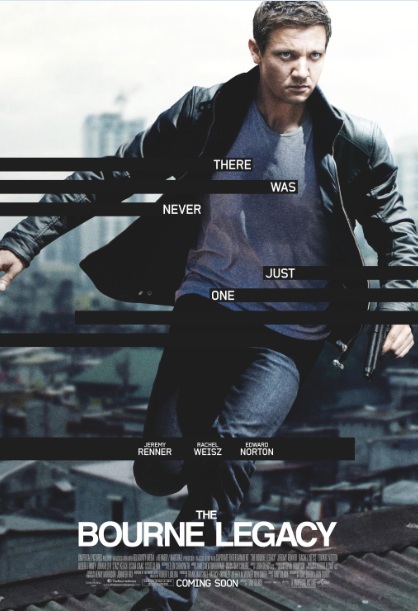
The Bourne Legacy Review


It's a rare sight indeed to see any series to maintain quality into a fourth iteration, and whilst there may indeed have been hope for the Bourne series - in the form of the great Mr Jeremy Renner stepping into Matt Damon's ass-kicking boots, and Tony Gilroy not only continuing writing duties, but also stepping into the director's chair - it's derailed by some strange additions to the mythos that don't sit comfortably within the context of the overarching story.

There's a nice sense of foreboding built at the start, with stark Alaskan landscapes, and a rugged, ragged-looking Renner clambering through it rather expertly. This is juxtaposed against Edward Norton and Stacey Keach, prevaricating in suits in Washington as they deal with the fallout of Jason Bourne's escapades. It's here that the film is most interesting, laying a groundwork that is actually rather elegantly interwoven with what we know about Treadstone and Blackbriar, with cameos from various major players that serve as a constant reminder of the climate of intrigue in the world we are being presented.

Performances are good - with Renner in particular going all out as Aaron Cross, notably performing the majority of his own stunts, and brooding both intensely and appropriately as the plot becomes silly around him. Norton brings his appealing brand of fast talk to the antagonist, and the supporting players all make a convincing go of it.

It's nicely directed too, but given the grade of action that Greengrass gave us, this was never going to really measure up. There're a few beautifully dynamic shots - a continuous tracking shot of Cross scrambling up the side of a house, bursting through a window and putting down a government assassin is the most memorable - but for the most part, whilst solid, it can feel a little visually perfunctory.

Then, about twenty minutes in, the story takes its uncomfortable turn - introducing a pair of pills that Cross has been taking that are...well, it's not properly explained at first, nor is it fully explained by the end. It feels a little cheap in terms of story-telling, using facts that the characters have known all along, but have simply foregone divulging to the audience to drip feed us ultimately incomplete information that plays against the hyper-realistic, psychological angle of the first three. Brainwashing, after all, isn't far-fetched at all - and whilst that element is still present, the movie also starts coining phrases like 'virusing out', and peppering the dialogue with pharmaceutical jargon that feels quite forced, and not in keeping with the precedent that has been set.

It also never manages to make a case for the audience creating relationships with the characters, seeming to assume that we'll dislike or like the characters based on who they are aligned with from the previous films.

In fact, were it not for the fact that we know Cross is meant to be the Bourne character of the piece, his character could be construed as the villain - a drug-addicted psychopath who more or less kills indiscriminately in pursuit of what he needs, as the powers that be do whatever they can to stop him. See this without knowing the story, and you'll likely be left scratching your head as to exactly whose side you're meant to be on.

Ultimately, this is something of a disappointment - visuals that have dropped significantly in  intensity, and a muddled plot that is both deeply rooted in, and yet somehow in polar opposition to its prologue, not really working on its own, nor as the Legacy that it purports to be. The performances and the action are entertaining enough to buoy the film just above the surface, and if we want to see Greengrass and Damon back in the saddle, it should be seen, but beyond that, it's the first real let down of the blockbuster season.

22 August 2012

Ted Review


Given that this is a Seth MacFarlane comedy, it's probably safe to assume that you've already made a decision as to whether or not you'll be seeing Ted. In fact, in all likelihood, you've rushed out and seen it already! Which makes reviewing it seem a little fruitless, but what the hey.

For those of you unsold on MacFarlane's unique comedy stylings, this isn't going to sway you onto him - the same scatological whimsy that is on display in his televisions shows pervades here, even so far as to cut to slightly silly asides that don't really hold any meaning beside being quite funny.

It is, however, a terrific setup, playing on the nostalgia of similar 80s/90s movies - you know the ones, modern fantasies that have a hint of magic, riffing on them beautifully with Walter Murohy's deliciously chintzy score, and a slightly serious, yet oft-distracted narration from Patrick Stewart that is the source of the film's first laughs.

Then there's the magic moment itself, and this is rather well built-upon, with Ted quickly becoming a celebrity, and then following the path of more than a few child stars as he grows up, retreating into obscurity

But what's really remarkable is that the film does indeed have a soul - strip away the ostensible gimmick of the animated cuddly toy as protagonist, and it would still work. It has something to say about friendship, love, obsession, parenting, and more, and as it explores these with coarsely poetic dialogue swirled into outlandish slacker melodrama - recalling Kevin Smith at his best - it creates characters that you can actually invest in. Come the denouement, when what the BBFC might refer to as 'mild peril' is introduced, you find yourself concerned for the wellbeing of a stuffed toy that you're not even sure can die, which is something of an achievement.

Whilst MacFarlane's direction is occasionally a little rudimentary, he never mishandles any particular aspect, though his talents are clearly more suited to some motes of live action over others. He does, however, drive it all forward himself with a great central performance as Ted, and his sense of comic timing also makes the overall transition to the big screen intact.

The rest of the cast a good too: Mila Kunis has already established herself as a good leading lady, and Mark Wahlberg makes for a capable foil, ensuring the story stays grounded. It's nice that there's also no traditional 'straight man' within the trio. Each take their turn, and this lends the dialogue an organic feel that serves to make the comedy rather satisfying. The supporting cast - bit part cameos as a majority - are all fun to spot, and each gets a nice few moments in the limelight. Most notable are Bill Smitrovich as Frank, Ted's manager - a bit of an oddball, but a memorable one - and Giovanni Ribisi as Ted's stalker, a character that was drawn from the same part of MacFarlane's mind as Herbert from Family Guy. Funny, but also mildly creepifying.

Ultimately, the film is simply good fun - tight editing eliminates dull moments, and MacFarlane's particular brand of comedy is as it ever was, and if it's your cup of tea, you'll find more than your share to like here. Certainly worth seeing.

31 July 2012

The Dark Knight Rises Review


NOTE: I try to avoid spoilers, but one can always infer anything from anything, so be warned, ye Sherlock Holmes deductive reasoning types...anyway...LET'S DO THIS S**T!!

*trumpet fanfare*

If I had to sum up The Dark Knight Rises in one word - and I don't, but I'll be damned if I'm not going to try - it would be simply: monumental. If you go away from is review with one thing in your head, let it be that: monumental. How the film achieves this is, of course, the rub of this piece, but let's say it again: monumental.

For a film which, at least initially, wasn't really believed in - both by its creators and the public at large - Christopher Nolan has lost none of his meticulous approach to film-making, and, alongside the rest of the cast and crew, has crafted a film that not only completes a trilogy with a bold flourish, but serves as a monument to the Batman mythos, both in terms of this particular story, and the legend as an entity.

Perhaps the most interesting thing about the story is that they've positioned it such a way that The Dark Knight can actually exist on its own. The only thing you need to know with regard to the second movie is that (actual spoiler alert) Harvey Dent and Rachel Dawes are dead - nothing else carries over, and what does is conveniently replayed via flashback. This allows them to rather cleverly sidestep the problem of matching a matchless movie, and allows them to get on with finishing the story.

In these terms, the Nolan brothers, along with David Goyer, simply couldn't have done a better job. The story they've created is expansive, and yet never forgets where it came from, taking story threads from the first film and intertwining them with threads lifted straight from the comics. It forges new backstories for most of the newly introduced characters, and whilst the web produced might not sit comfortably with fans of the stories that this draws on, it's still an elegant stripping down of the mythos that fits perfectly - both tonally and thematically with its predecessors - and is fully self-contained.

Particularly impressive is the adaptation of Bane's character into the franchise. Whilst Ledger's Joker was a terrorist who 'just wants to watch the world burn' - representing our collective fear of the unpredictable nature of the psychologically unbalanced - Bane here is a force that's driven by belief in a cause, and a hatred of Batman so deep that you can smell it in his voice.

It's not quite revealed why until the denouement, but the tension generated by the build-up is capitalised on brilliantly, and that culminates in a scene that,as it progresses, builds a horrible sense of dread - and this is a monument to the characters and stories that have been crafted, that you feel such genuine concern for those on screen.

So having created a story that is essentially a duology with a Joker-based interlude in the middle, you have to set about filming it. And this, my friends, is where the truly spectacular stuff starts going down.

The action chops that Nolan honed on Inception are in full show here, and it's all captured with Wally Pfister's jaw-dropping IMAX cinematography. Set pieces bristle with iconic imagery throughout, and the fist fights are abrupt but bone-crunchingly satisfying, filmed with a broader stroke here than in the previous two.

Ferocious physical performances from all those involved also give the fights a harder, more immediate sense of threat than the previous films - and this is no small part of the above-mentioned dread-filled sequence. Tom Hardy in particular provides a predatory stalk to Bane that, coupled with his deeply unsettling vocal register, makes for a villain that is entirely different, but exactly as elementally terrifying as the late Mr Ledger's agent of chaos. Bale is still both a good Bruce Wayne and a good Batman, if only for the fact that the duality of the character has been mostly jettisoned. The scene-stealer is Anne Hathaway, though, smouldering dangerously as Selina Kyle, and pulling off a feline physicality without a single reference to cats. Then there's Joseph Gordon Levitt. To discuss his performance is to ruin the fun of it, so just keep an eye on him, yeah?

If there are problems, they arise only due to the scope of the vision. Despite never truly boring, the story sags a little in the middle under the weight of its own plot threads, and takes a little while to pull itself back together. One appearing character feels almost crowbarred in, and it is occasionally a little too pacily edited for its own good.

It's perhaps a little bit early to brand the film as the best of the series - a rewatch is in order, just to make sure it did all add up. But what's here is a terrifically exciting movie that only threatens to bore in a slightly overlong, Batman-free middle section, and considering the film is 2 hours and 45 minutes long, that this is only a threat is something of an achievement. The IMAX cinematography and the imaginative set pieces are the highlights, but it's also buckling at the seams with iconography that'll stand the test of time. See this monument. See it soon, and in as big a screen as you can.

15 June 2012

Prometheus Review


So here it is, after a 10-year wait - so long absent from science-fiction, the man who brought us Alien and Blade Runner finally makes his return to the genre. Not just that, but a return to the Alien mythos - albeit reduced in significance when compared to the original concept for the film. Couple that with the a title that has all sorts of mythological subtext, and you have it: Prometheus. Sadly, the film is very much one of two halves.

The set-up is genuinely fantastic. Archaeologists discover a curious constellation of stars that crop up in the artwork of many different ancient cultures on Earth, despite it being impossible for them to have communicated with each other. There's also the fact that there's only one possible star cluster that matches, and those that made the drawings couldn't possibly have been able to see it. So a plan is made to send an expeditionary force to the cluster - and specifically, a life-supporting moon in orbit around a gas giant - to find out what's there, and why it seemed like we were being told to go there.

The first hour or so of the film's two-hour running time is dedicated to the set-up - motivating the characters, moving them to the aforementioned moon, and laying the framework for what initially promises to be a spectacular second and third act. Visually, it's absolutely breathtaking from the get go - the opening sequence is incredibly pure and thoughtful sci-fi, bringing to mind Arthur C Clarke's style of 'show, don't tell'. It offers no explanations - there's not a word dialogue - it just happens, and it's an incredibly arresting, disturbing and ultimately intriguing sequence that serves to make the set-up that little bit more effective.

That's not to say the rest of the film pales in comparison, with detailed, intricate special effects and a lovely contrast between the stark, industrial practicality of human technology compared with the organic, H R Geiger-designed and inspired alien architecture, an aesthetic brought over from the films that preceded it. The visuals are draped in Alien mythology, both overt and subtle, but never intrusive, and it's these design details, coupled with Scott's still-keen eye for the visually majestic, and Dariusz Wolski's gorgeous capturing of the really-quite-alien Icelandic landscapes, that give the film an incredibly rich visual palette.

The performances, too, are for the most part good, with the stand-outs being Idris Elba's ship captain Janek, Charize Theron's Vickers, the frosty commander of the mission, and Michael Fassbender's android David. It's Fassbender who truly steals the show, utterly nailing an unsettling, Lynchian vibe to the character. There's something not quite right about everything he does, and one of the film's better moments is a study of quite what androids get up to when all the humans are in hypersleep, although again, this appears in the film's first act.

Moving on to the second half, this is where the problems with the film start to raise their heads. For a group of individuals purporting to be on an expedition seeking out God himself - or the closest available substitute - the crew of the Prometheus do not make intelligent (or even semi-intelligent) decisions when under pressure. There's a lot of talking going on the first act - with the grand idea of finding the Creator being discussed with a decent level of intelligence and a dab of philosophy to boot and whilst this permeates the film, not a one of the character's actions in the second half reflects the grand plans made in the first.

In fact, not a one of their decisions make sense - all sorts of questionable behaviour abound, with characters not communicating with each other despite a pressing need to do so, and making immoral and bizarre choices that jeopardise both themselves and the crew, despite ostensibly acting in their own interests. Its not even a case of us, having seen the preceding films, being one step ahead of the characters - these people are on the frontier, light-years away from home, with the best communication technology imaginable, and they are simply not using it, logic be damned.

There are some lovely moments - moments drenched in the mythology, moments of fascinatingly awful body horror, and moments of pulse-pounding adrenaline, but the decisions that chain them together simply don't smack of a crew who could ever or even should ever have been put together. Perhaps this is one of the movie's points - that putting together this sort of mission requires more than 2 years planning and a bit of money thrown at it - but in a world where horror and sci-fi tropes get subverted as often as they get played straight, in a film like this, intelligent characters making intelligent decisions is a must, and there's a distinct lack of this in Prometheus' second and third acts.

There's other minor irritations, such as a dearth of actual answers to both questions we had before, and those that were raised whilst watching the film; the awkward, unnecessary international casting follies - Englishman playing American? Swede and Australian playing Brits? Really? Idris Elba did't need to be American; Noomi Rappace didn't need to be British; Guy Pearce didn't need to be in the film at all but for that one TED 2023 viral that went out. But perhaps the most irritating of all is a piece of body horror involving a robotic surgery machine that is well played visually, but is stymied thematically by an irrelevant contrivance in its build-up that is almost entirely endemic of the film having had its script drastically over-hauled during production.

For a film that had so much riding on it - both in terms of audience expectation, and in terms of the mythology driving it - the finished product is something of a mixed bag. The visuals impress, the attention to detail is astonishing - subtly integrating the film into Alien canon, whilst never dictating the direction of the plot - and as has already been said, the first hour of the film is a masterclass in setting the scene. But the sheer lunacy of some of the characters decisions, the lingering smell of grinning incompetence over the finale and a plethora of other oddities that all exclusively stem from weak writing in the second and third acts means the story lacks resonance, and without this, the film ultimately fails to engage properly. See it for the visuals and the deepening of the Alien mythos - even if it does raise more questions than it answers. Just temper your expectations of the story being told around it.


14 June 2012

Max Payne 3 Review


Sitting, as we are, in a year of long-awaiting entertainment - The Dark Knight Rises, Diablo 3, Halo 4,  The Avengers, Prometheus...the list goes on -  it's perhaps appropriate that one of the best games to saunter up is among their number.

Originally set for release in 2009, it was jostled about for a while - mostly thanks to a 'it'll be done when it's done' attitude - and has finally hit a console near you, and it comes with a heavy dose of history on its shoulders.

If you haven't played the first two Max Payne games, you genuinely missed out - the original is a prototype for the modern action game, with tight, beautifully responsive action wrapped in a gorgeously written story, told beautifully and intruigingly through the medium of graphic novel interludes, rather than cutscenes. It was a hallmark in cinematic gaming, bringing the concept of bullet time into gaming, and executing it flawlessly, with the gameplay not just looking great - bullets whizzing about your head in slow motion, sending your own right back as you fought your way through fantastically realised environments - but feeling great, with slick controls, a varied arsenal, and a satisfying difficulty curve keeping you engaged from start to finish.

The second, subtitled 'The Fall of Max Payne', continued the trend, coupling an escalating story - including a romance with what is still one of the best female co-leads any medium of story-telling has produced - with for-the-time incredible graphics, and a beautifully weighted adaptive difficulty system, all alongside the outrageously tight shooting mechanics that made the first so good. All of this meant that the franchise found its way into the 'fondly regarded' section of many a memory warehouse, and this was only mildly tainted by that appalling cinematic entry. 

So along rumbles Max Payne 3. Gone are the original developers and writers - Remedy Entertainment and Sam Lake respectively - in are some new kids on the block. Or rather, some old veterans with a shotgun on the porch: Rockstar and Sam Houser. It's a shift in creative team that may make some wary, and others excited, but either way, it's actually a match made in heaven.

Shifting the story forward in real time, it picks up with Max a now-aged ex-cop, drowning his guilt and sorrow in bottle after bottle of whatever alchohol is closest to hand, and a near-lethal daily dose of painkillers, that - thanks to our gameplay habits in the first two games - he's now addicted to. After a run-in with the Punchinellos - ah yes, the first act villains from the other two! - Max ends up working for a rich Brazilian family in what was to be a cake walk, guarding their brattish, drunken children from...well, nothing. But as ever, things never seem to go right when Max is involved, and a botched kidnapping attempt is the catalyst that creates a wave of violence and death, leaving a trail of bodies straight to the heart of the endemic corruption in Sao Paulo.

The shift in tone from the dark, snow-draped visuals of New York to the brighter asthetic of sunny Brazil is handled really rather well, with the first and second acts juxtaposing the two design ethics before shifting into a gloriously sun-kissed final act that, coupled with the story's noir groundings, serves to give the game a vibe similar to that of the late Tony Scott's opus, Man on Fire - darkness that simply cannot be overwhelmed by the light, no matter how bright and heavily armed.

This is all down to Houser's writing - and to make a bold statement, if video games have anything even vaguely close to a Quentin Tarantino, Houser is it. He's a man who understands video-games, who's grown up with them and he rides a fine balance between a gritty tale, seriously told and a knowing pastiche of both the games that preceeded it. Max's dialogue in particular is fantastically written

In terms of execution, the game is close to flawless. Characters look great without delving into the uncanny valley that LA Noire so comfortable resided in, and the detail in the animation, along with the fluidity of the transitions, is genuinely astonishing. Changes in expression this subtle are something of a rarity in video games, and this was done without that fancy facial capture tech that practically broke Team Bondi in half as they tried to get it working. The physics engine is also beautifully integrated with the Euphoria animation system, making for environmental interactions from both Max and the other characters that is rarely the same twice, with glass smashing realistically as you plough through it head first, then beer bottles and wine glasses flying elegantly aside as you slide along a bartop, mowing down a roomful of bad guys as you go, even as you haul yourself back onto your feet.

Gameplay is split between the above-mentioned running-gunning-and-Shoot-Dodging-in-slow-motion that is the series' hallmark, and the new addition of scripted set pieces that take a page from Wanted: Weapons of Fate's book when it comes to quick-time events.

But perhaps the most impressive technical achievement on display here is Max himself. Not some static, ever-regenerating man/tank hybrid - no, instead, he's a character that actual changes as things happen to him. Bullet wounds persist through cutscenes in each chapter, and Max noticeably starts moving slower the more damage he takes.

This creates an interesting dynamic in the controls - Rockstars mastery of this particular aspect of making games means that it actually feels like you're controlling a middle-aged, slightly drunk, slightly fat ex-cop, with the trademark Shoot Dodge (yes, apparently we have to capitalise that as well...) and Bullet Time being more or less his only edge. This may seem like an odd compliment - 'who want's to feel that?', I hear you ask - but it creates an attachment to the character that goes beyond him simply being a well-written, fleshed out human being. Then there's the fact that Shoot Dodging has a more than reasonable number of great moments, peppered with moments of intentional comedy, and the odd minor irritation when you manage to break the physics, or get filled with holes due to your being lying on the ground out in the open, desperately scrambling to your feet.

This serves to make an interesting tactical choice in game - there's a conflict between looking, to coin a phrase, 'pretty fucking awesome', and the actual practicality of the Shoot Dodge, encouraging you to find the incredibly satisfying midpoint between diving about like a mad-man and the more tactical, cover-based aspects of the gameplay.

If there are problems with the game, they're three-fold. First, there's the obnoxiously long loading times - I only have the Xbox version for reference, but even after installing the game onto the hard disk, each chapter is broken up by an excrutiatingly long loading sequence, and it serves to break the flow of the story rather ferociously. It's lucky that the game is very much worth waiting for, otherwise it might've been verging on a deal-breaker. It's not so bad on your first play through, but when it comes time to hit New York Minute mode, and the multiplayer, the long waits for the action aren't particularly welcome. It also fails to change the formula in any particularly meaningful way - it's still you and your arsenal against wave after wave of baddies, and it does start to get a tiny bit repetitive towards the end. There're also three rather frustrating 'boss battles', that didn't really need to be in there, but the adaptive difficulty thankfully makes these pass quickly.

Overall, this is an experience not to be missed. A writer who's never produced better, coupled with a studio at the absolute top of their game artistically and technically, it's moving, heart-pounding, often funny and above all, entirely absorbing, drawing you in to a sleazy world of corruption, violence and tragedy, with Max a broken guardian angel, giving one last stab at dishing out some justice in an unfair world that seems to be set against him. It's a sight to behold, and if you only manage to play one game this year, make it this one.